Community Reflections
The Elephant in the Room
Reflection on Matthew 18:21-35
September 13, 2026
Sonia Caus Gleason
In south Central India, in the Nilgiri Hills, 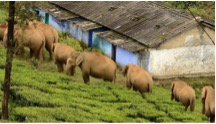
 the Adavassi and other indigenous peoples live alongside nature and a range of living creatures, including elephants. People and elephants live alongside one another the way we city folks live alongside turkeys, rabbits, and raccoons, sort of. It’s a bigger job because well, elephants are bigger, they eat 22 hours a day and travel in herds of 6-20, led by a matriarch. More importantly, it’s not about people just putting up with them, but engaging with them as equals, equally important as people.
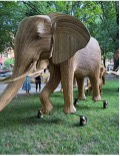 An artistic witness to this interdependence rolled into Boston last month just a few blocks away (on Commonwealth Avenue. Raise your hand if you’ve had a chance to be with them. There’s still time. Today is their last day.) They also bear witness to many values that Pope Francis wrote about in the encyclical Laudato Si, and that were central to the life of his namesake, Francis of Assisi, our church’s earliest documented environmentalist.
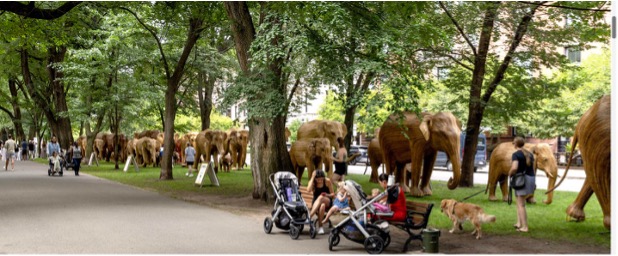
We all belong to one another as part of God’s vast creation: the amoeba, the atom, the caterpillar, the crocus, the rock, the soil, the sea – and all creatures. It is so vast, so intricate. And no one element more important than the next.

These are countless gifts oPered to us, revealed to us sometimes one flower petal, one baby’s toe, one tomato, one turtle at a time. How can God love us so lavishly, so well? It can be hard to take in and harder to hold present consistently.
Serious personal and societal struggles inevitably take our attention. So do smaller distractions: the annoyances of people and gadgets, the busyness of life, the pressure to be efficient or successful or perfect, to buy and possess this and that. In some cases, we have choices that can make us better. At the same time, we can also see ourselves trapped in economic and political systems and practices designed to benefit a very few at the expense of the rest, and of the earth itself.
God’s splendor is ever present and at the ready for us, though it can go unnoticed. Too often it can be the elephant in the room.
As balm and antidote, Christians around the world have designated an annual Season of Creation, from September 1 through October 4, the Feast of Saint Francis. At this time, we’re called to remember, pray, and take action to honor our common home.
This call is even more urgent than when the encyclical was released 11 years ago and the Gospels guide us in ways to tend to it. Jesus is constant in telling and showing us how to be faithful, giving us many examples and entry points into discipleship. Love is always at the heart of it: love manifested in teaching, in healing, dealing with authorities, love in dining with His friends, love in hanging out with delinquents and outcasts, love in oPering His life, love in His rising.
Today in Matthew’s gospel, Jesus speaks of love made real in compassion and forgiveness. In the parable a king has a servant who owes so much money, that it never could have been paid back in a lifetime. Scholars have run the numbers. The servant goes completely freed from the impossible burden. It’s life changing for him and his family. Yet when someone owes that servant a small amount of money, he has the fellow servant put in prison.
What’s with that? Did he even notice or appreciate the king’s level of generosity? Was there something so terrible going on with him that he forgot? Was he so terrified of losing economic ground that he couldn’t give a guy a break? Should I be more curious and less unforgiving as I wonder?
If he really understood and took in that the king was not just being super generous but also modeling a way to live, perhaps it would have been diPerent.
The king felt compassion, put himself in the other person’s shoes. There was no special oPer to let him pay in twenty, easy installments. No special interest rate. No principal.
This is our invitation, the dare to discipleship. We are called to go all in. To find ways to forgive the small things and the ones that feel like forgiving is giving away a fortune. When someone does something wrong in the classroom, the zoom room, the public square, at the kitchen table, we’re not to pretend something didn’t happen. We not to say, “I forgive you” or “I’m sorry” and not really mean it, or to say it without acknowledging the specifics of the harm.
Instead, we’re called to summon up our compassion, which let’s face it, sometimes is much easier than other times, and to find a way to both oPer forgiveness and ask for it readily.
In addition to expressing heartfelt forgiveness, in this Season of Creation, Laudato Si’ calls us to personal and communal action. Forgiveness means restoring fairness, equilibrium. How do we go to the next level with recycling and reusing, reducing our carbon footprint, our materialism? How do we deepen our ecological education? How do we do our part in collectively countering systemic harms and greedy corporate entities, especially knowing that marginalized peoples always pay the highest price? What aspects of addressing caring for our common home, environmentalism, materialism come more easily? What’s harder?
These are big asks of us. There’s so much going on. Some of us come to this chapel starting a new school year; taking up the fall rhythms of daily work; tending to tough relationships; forging ahead with other charity and justice causes we’re dedicated to. Some of us are in a season of deep grief. As we remember 9/11, many of us dwell in heartbreak even as we honor the ones who ran toward danger. Some of us are starting or midstream on pilgrimages, quests, adventures. Some are basking in joy, unexpected or long-awaited. And not least, today we’re poised to bless and commission a new Executive Director, the first lay person and woman to hold this position.
However our hearts are this morning, we’re invited to notice the splendor of all creation, to recognize it as ongoing forgiveness and gift.
And we’re invited to take in and embrace one another, this table, every table, every rabbit and elephant, as sacred.
May our awareness and awe propel us, more and more, to be Christ’s compassion and forgiveness wherever, however we find ourselves.
________
References
Barclay, William (Eng.translated with commentary). The Daily Study Bible Series: The Gospel of Matthew. Volume 2, Revised Edition (1958). The Westminster Press.
Brown, R. E., 1928-1998; Fitzmyer, J. A; Murphy, R. E., 1917-2002; Martini, Carlo Maria Cardinal, (1989). The New Jerome Biblical Commentary. Englewood CliSs, NH: Prentice Hall.
The Great Elephant Migration: A Coexistence Story. Uploaded September 12, 2026. Harrington, Daniel J. The Gospel of Matthew (2007). LIturgcal Press.
Kohleberger, J.R. (1991). The NRSV concordance unabridged: including the apocryphal/deuterocanonical books. Grand Rapids, MI: Zondervan Pub. House.
Pope Francis. Laudato Si’: On Care for Our Common Home (2015). Vatican Press. Salvatorelli, Francesco. La Vita di San Francesco (1982). Editrice Einaudi.
PDF version of this reflection — 09132026 Preaching 7 times seventy